When Violence Isn’t Personally Experienced, but Still Hurts:
- Heather Rogers
- Dec 28, 2025
- 5 min read

The Neurobiological and Psychological Impact of Witnessing Harm
See_life_as_a_Muse , article from Substack, Nov 14, 2025
In recent weeks, the public has been inundated with imagery and reporting on government raids, forced removals, and the release of documents related to high-profile sexual exploitation cases. For many individuals, particularly those with histories of assault, abuse, coercion, or systemic harm, this constant stream of content carries a significant psychological and physiological impact.
Although the violence being shown may not be happening to them directly, countless survivors are experiencing symptoms of fear, panic, numbness, or overwhelm. Many describe feeling as though they are back inside moments they worked hard to heal from. These reactions can be confusing or shame-inducing, especially for those who have spent years in recovery.

However, such responses are not signs of fragility or oversensitivity. They are rooted in well-documented neuroscience and the lived reality of trauma. Witnessing violence even indirectly can reawaken trauma networks in the brain and body with remarkable intensity.
Understanding why this occurs is essential for building trauma-informed communities and creating more responsible approaches to public communication.
Vicarious Activation: Violence Does Not Need to Be Direct to Be Impactful
Trauma resides not only in the narrative memory of an event, but in the nervous system itself. The body responds to certain sights, sounds, and emotional tones long before conscious thought can intervene.
When individuals with trauma histories witness scenes involving force, helplessness, intimidation, or domination, the autonomic nervous system may interpret these cues as an immediate threat.
Whether the stimulus is video footage of an ICE raid, testimony from a high-profile assault case, or audio of a violent encounter, the sensory input may closely resemble signals encoded during the original traumatic experience. The subconscious system recognizes patterns instantly:
“I have experienced something like this before. This is a danger.”
This process is not imagined, exaggerated, or dramatic.It is biological.
The Neurobiology of the Trauma Response
The Amygdala: The Alarm System
The amygdala acts as the brain’s rapid-response danger detector. It processes emotional threat signals faster than the rational mind can intervene. For trauma survivors, the amygdala becomes sensitized through past harm and may activate quickly when confronted with familiar cues such as shouting, power imbalance, or aggression.
The Hippocampus: Memory, Time, and Sensory Recall
The hippocampus stores memories and creates a sense of time. Trauma, however, disrupts this process. Rather than forming structured narratives, traumatic memories are often stored as fragments:
sensations
images
sounds
emotional flashes
physical reactions
When a survivor later witnesses violence, the hippocampus retrieves these fragments in an attempt to protect. This can trigger intrusive memories, flashbacks, or overwhelming sensations that feel as though the past is occurring in the present.
The Prefrontal Cortex: Return to Logic and Safety
During a trauma trigger, the prefrontal cortex, the part of the brain responsible for reasoning and grounding, goes partially offline. Grounding practices help reactivate this region, restoring the ability to think clearly, self-regulate, and assess real-time safety.
The Body’s Memory: Physiological Manifestations of Trauma

When the brain perceives danger, the body responds immediately. Survivors may experience:
rapid or pounding heartbeat
shaking or trembling
nausea or stomach tightening
numbness or dissociation
tension in the chest or throat
difficulty speaking
sudden exhaustion
headaches or dizziness
These symptoms are not dramatic. They are the body’s attempt to protect itself.
Why Witnessed Violence Feels Like Reliving Personal Trauma
The brain does not distinguish sharply between real danger and perceived danger. A typical sequence might look like this:
The amygdala detects a familiar threat. Even if the threat is occurring on a screen.
The hippocampus retrieves sensory fragments from past trauma. The brain pulls up what feels relevant to survival.
The nervous system floods the body with signals of survival. Faster than conscious thought can intervene.
The individual feels the sensations of their earlier trauma. Even without remembering the specific event.
The body reacts as though the past is happening again.
This is not regression. This is protection.
The Hidden Burden: Shame, Self-Blame, and Misunderstanding
Many survivors respond with self-criticism:
“It wasn’t happening to me.”
“Why am I reacting like this?”
“I should be over this.”
“Other people have endured worse.”
However, trauma responses are not governed by logic. They are governed by physiology, conditioning, and the body’s commitment to survival.
There is nothing weak about reacting to violence. There is wisdom in it.
Mitigating the Impact: Grounding and Nervous System Regulation
Effective support for trauma-affected individuals requires strategies that engage the body’s physiology, not simply its cognition. The following evidence-supported techniques help restore a sense of presence and safety.
Breathwork and Vagus Nerve Activation
Slow diaphragmatic breathing, humming, chanting, or gentle vocalization activates the vagus nerve and supports nervous system recovery.
Somatic Discharge
Gentle shaking or slow walking helps metabolize the adrenaline and tension that accumulate when the amygdala activates.
Temperature-Based Reorientation
Holding something warm or cool interrupts the threat loop and anchors the mind in the present.
Self-Contact
Placing a hand on the heart or belly offers containment and grounding.
Integrating Trauma-Safe Breathing Practices
Breathing directly influences the nervous system’s threat response. Two practices are exceptionally safe and effective for moments of overwhelm triggered by witnessing violence.
Humming Breath: Calming Through Vibration

A gentle hum on the exhale creates vibration through the throat and chest, stimulating the vagus nerve and helping the body shift out of fight-or-flight. This practice anchors attention through sound and sensation, particularly helpful when thoughts feel scattered or the body is in a freeze response. The hum signals: You are here. You are safe enough to soften.
Gentle Sighing Breath: Releasing Without Forcing
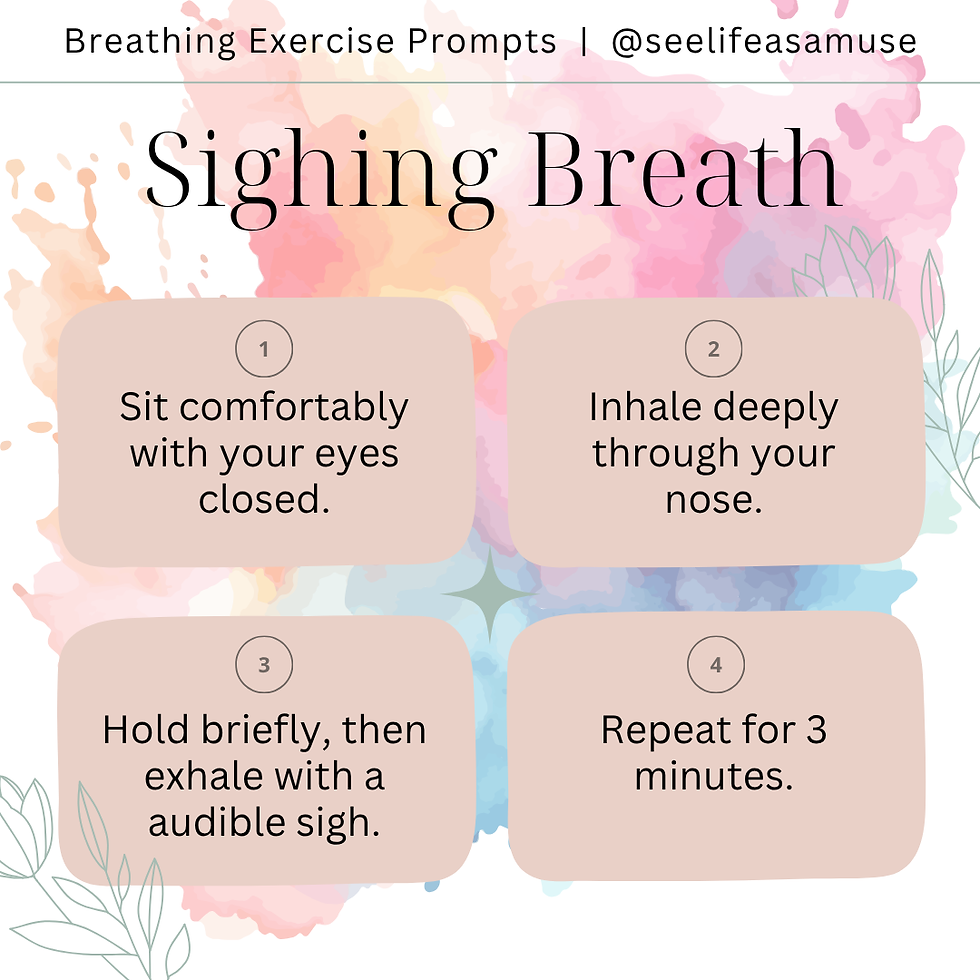
This breath begins with a natural inhale and ends with a soft, unforced sigh. It relaxes the diaphragm, lowers the heart rate, and communicates to the amygdala that immediate danger has passed. For individuals experiencing emotional overwhelm, fear, or sensory overload, the sigh is one of the quickest ways to interrupt the stress cycle and restore internal space.
Both techniques are discreet, accessible, and effective for survivors navigating reactivation.
The 5-Senses Grounding Method
A structured sensory exercise includes:
Five things you can see
Four things you can touch
Three things you can hear
Two things you can smell
One thing you can taste
This re-engages the prefrontal cortex and anchors the individual in the present moment.
Using Sensory Awareness to Evaluate Safety
Beyond grounding, the senses provide concrete data about whether the environment is safe.
In a safe environment, cues may include:
familiar objects
comfortable textures
predictable sounds
neutral or comforting smells
recognizable tastes
In potential danger, cues might include:
chaotic or unfamiliar visuals
pain or discomfort
yelling or sirens
smoke or chemicals
metallic or stress-related tastes
This method distinguishes internal activation from external threat and helps the nervous system orient accurately.
Toward a Trauma-Informed Society
Repeated exposure to violence through media, policy enforcement, or public discourse compounds personal and collective trauma. Healing requires:
responsible reporting
content warnings
sensitivity in how harm is discussed
community awareness
education about nervous system responses
empathetic communication
Trauma literacy is essential for public health, safety, and community resilience.
The impact of witnessing violence is profound, honest, and grounded in the neurobiology of trauma. Survivors may experience intense emotional and physical responses not because they are fragile, but because their bodies remember what danger feels like.
Through trauma-informed practices, breathwork, grounding, sensory awareness, and community care, we can help survivors return to the present with dignity and safety. By understanding the body’s responses and offering compassionate support, we create a society that protects rather than retraumatizes.
A society that honors truth, upholds humanity, and supports healing.


Comments